Beyond Billable Hours: The Blueprint for the Next-Generation Consultancy
How Christian Underwood turned a strategy practice into a software business by deciding what not to sell. From the LEADERS IN CONSULTING Munich Summit, 2 July 2026.
An 82-year-old company owner and his 40-year-old son once ran their company’s strategy process on nothing more than a bare-bones task-tracking website: no AI, no polish. That website was the first version of StrategyFrame.
Christian Underwood, co-founder and CEO of StrategyFrame AI, priced it at €5,000 a year and told his existing strategy clients that hiring him meant using the software. They bought it. Three and a half years later, that family business is still on the platform, still paying the same price.
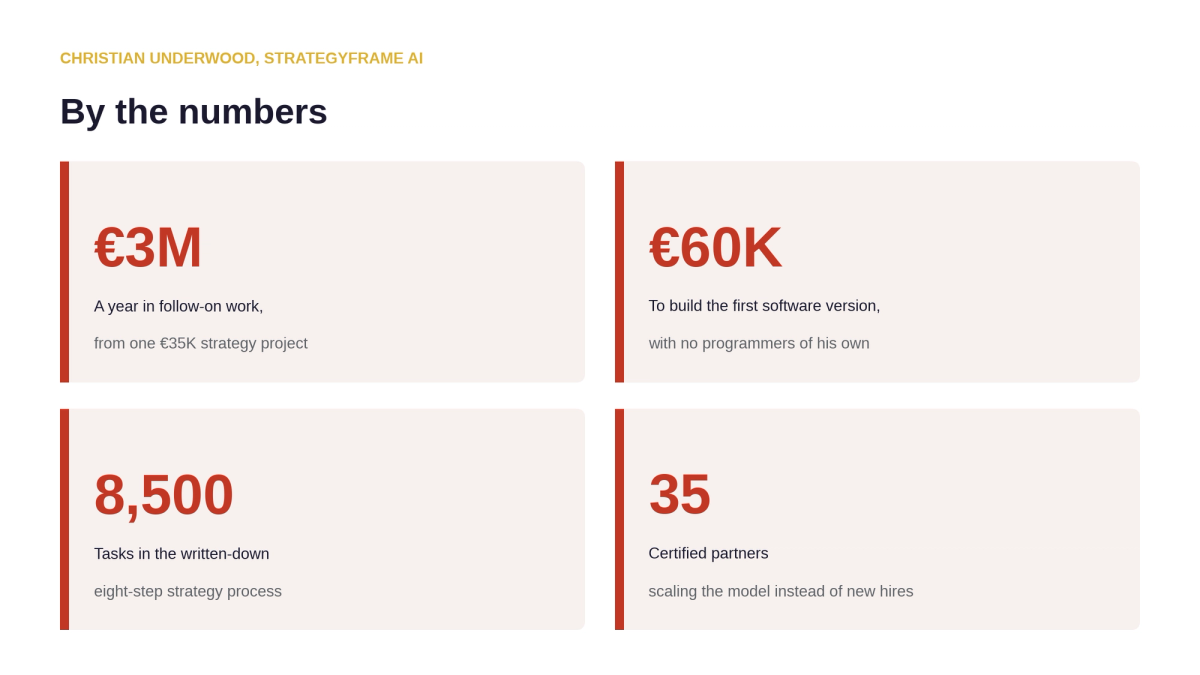
Before StrategyFrame, Christian spent a decade running a one-partner strategy practice and, with no programmers of his own, had the first version built externally for around €60,000.
TL;DR
- From projects to licenses: as a consultant, a €35,000 strategy project at GEA led to about €3 million a year in follow-on work. Christian then changed the model to earn from software licenses instead.
- First product: about €60,000 to build, done by an outside provider since he had no programmers, and sold for €5,000 a year.
- Target client: 200 to 5,000 employees, with a sweet spot of 200 to 800. Priced on complexity, not headcount.
- Client data only: the AI runs on data the client supplies, with no default web access, so the client owns the responsibility for it.
- Partners, not hires: instead of hiring, the company scales through a certified-partner network, with 35 partners so far.
Pick One Thing to Sell
His last big consulting client before he switched models was GEA Group, a DAX 40 company.
“I did the IT strategy for around 35,000 bucks, but then I earned the whole IT reorganization. I earned the change part in the S4 HANA transformation. We got the global security initiative and the global business process management, around 3 million per year out of 35,000 bucks.”
For about ten years, Christian earned at most around €30,000 on the strategy work itself. The money came afterwards: winning the client’s trust turned strategy into what he calls a project-generating machine. But the strategy work alone paid too little to build a business on, so he changed the model to earn from licensing the process instead.
He also gave something up. He had done transformation, post-merger integration, and branding for years, and like most consultants his instinct was that he could do nearly anything a client would pay for. He decided to do one thing: the strategy process itself. Everything else got dropped. The most important decision, he says, was what not to do, an idea he took from Hermann Simon’s work on hidden champions.
His advice to consultancies starting with AI follows the same logic: don’t run 200 use cases in 20 fields, or you just throw money out the window.
Five Questions, Starting With the Customer
Christian ran the room through a 15-minute self-reflection using his framework. Consultants often debate whether to start with the market or the customer. Christian always starts with the customer.
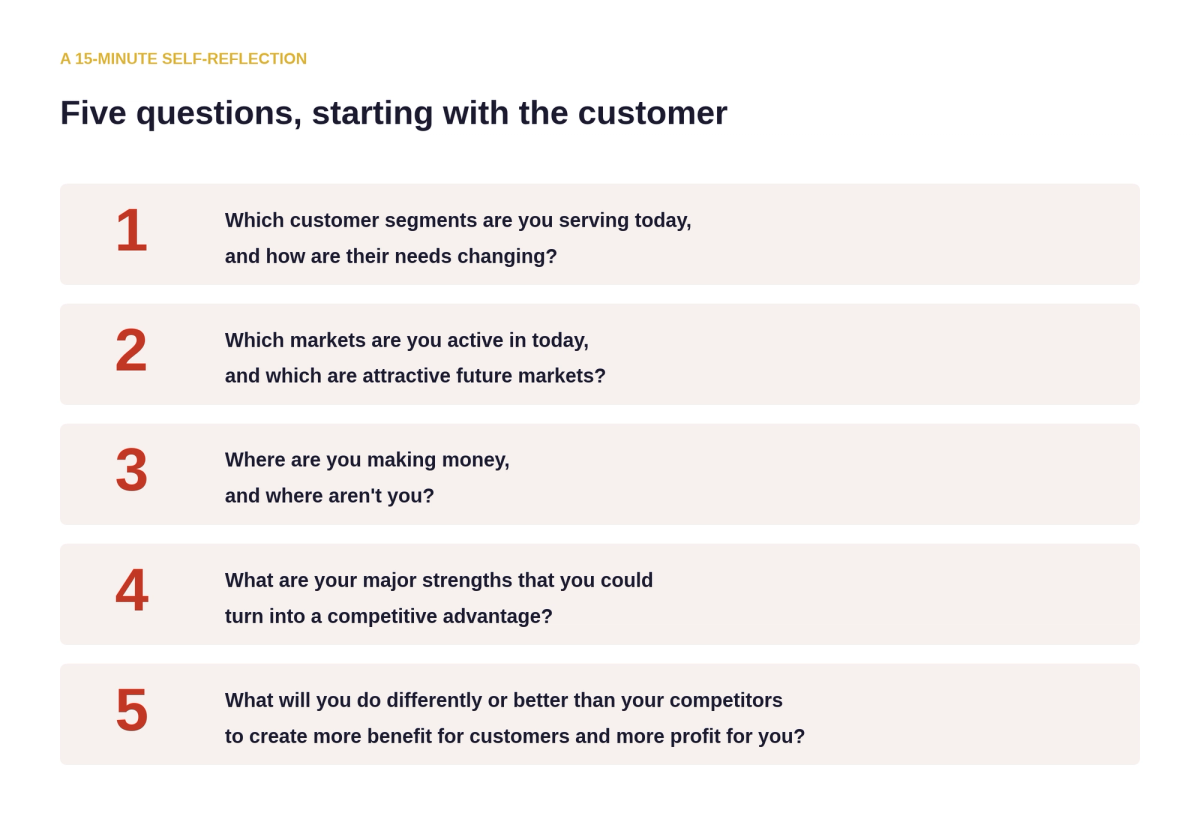
Christian calls that last combination a winning proposition.
“The combination of the customer benefit and superior profit, what is called the winning proposition, not the value proposition, because you can drive value like hell and earning nothing in money. So it’s about winning.”
A company can create huge value for a customer and still earn nothing from it. A winning proposition names who profits, and by how much, on both sides.
Three Kinds of Client
Answering the first question for his own business, Christian found his clients fall into three groups.
| Group | Who they are |
|---|---|
| Never hired a consultant | About a third of clients, some with a 200-year company history |
| Can't afford big consultancies | Another third; it's a price point issue, but they want a good strategy |
| Don't like consultants | Big ambitions; they use the tool on their own, with StrategyFrame making sure it works |
Write the Process Down First
The book came before the software. Christian and his academic co-founder, Prof. Dr. Jürgen Weigand, wrote the entire strategy process down first, in their book Hope Is Not a Strategy: an eight-step framework broken into roughly 8,500 individual tasks. That document became the map for what to digitize, and the software built around it is the same €60,000 first version, built by an outside provider.
Christian had an advantage here: he was the only partner at his consultancy. In a firm with 25 partners, he jokes, you have 26 different strategy approaches, and agreeing on one standard is always the most crucial discussion.
Once the process was written down, it became software clients used directly, even before AI. Then came AI agents, at first each built for a single task, like customer analysis or market analysis. The architecture is different today.
Two Questions From the Room
First, whether the AI pulls from the open web. Normally the AI doesn’t connect to the web; it works on the data the customer puts in, which keeps managers responsible for that data. A web button launched the week before the summit, and anything pulled in that way, or pasted in from tools like ChatGPT, is marked so users know it may be less reliable. Benchmark data comes from StrategyFrame’s own database, and crawled data is always checked against its sources.
Second, who it is for. Potential customers range from about 200 to 5,000 employees, and the sweet spot is 200 to 800. The reason is complexity, not headcount: by 200 people a company already has real complexity but usually no head of strategy, and up to 800 it often spans different business units globally. The platform is priced on that complexity. Above that range he is wary: chasing a Bosch means hundreds of calls and nothing happening, which a bootstrapped company cannot fund.
Where Do You Stand?
- If you had to drop everything except one thing you sell, what would survive, and is it the thing you are actually best at?
- Have you written your core process down completely, or does it still live in the heads of individual partners who each run it differently?
- Does your pricing track the complexity of the client’s problem, or the number of people you throw at it?
About Christian Underwood
Christian Underwood is co-founder and CEO of StrategyFrame AI, a strategy platform built for Germany’s Mittelstand. He previously spent around a decade running his own strategy practice and co-developed the framework behind the platform with Prof. Dr. Jürgen Weigand. Today, StrategyFrame scales through a certified partner network rather than a traditional delivery organization.
StrategyFrame AI is a digital strategy platform that helps companies structure, run and scale their strategy process. It combines a standardized strategic framework with software and AI support, helping leadership teams turn complex strategic questions into a clear, repeatable process without relying on large consulting teams.
…
This article is based on an episode of the LEADERS IN CONSULTING Podcast, hosted by Sammy Gebele, Founder of SAWOO.
If you want to hear the full conversation behind this analysis with Christian, you can find the episode in the podcast section.
If you’d like to stay in the loop on future deep dives and community updates, you can subscribe to the newsletter here.
For more perspectives on how leaders are navigating challenges like this, follow LEADERS IN CONSULTING on LinkedIn.