Grow Revenue Without Growing Headcount: A 900-Person Firm Achieved This, and You Can Too
How Martin Zitz doubled Forterro’s services revenue while headcount grew by half. From the LEADERS IN CONSULTING Munich Summit, 2 July 2026.
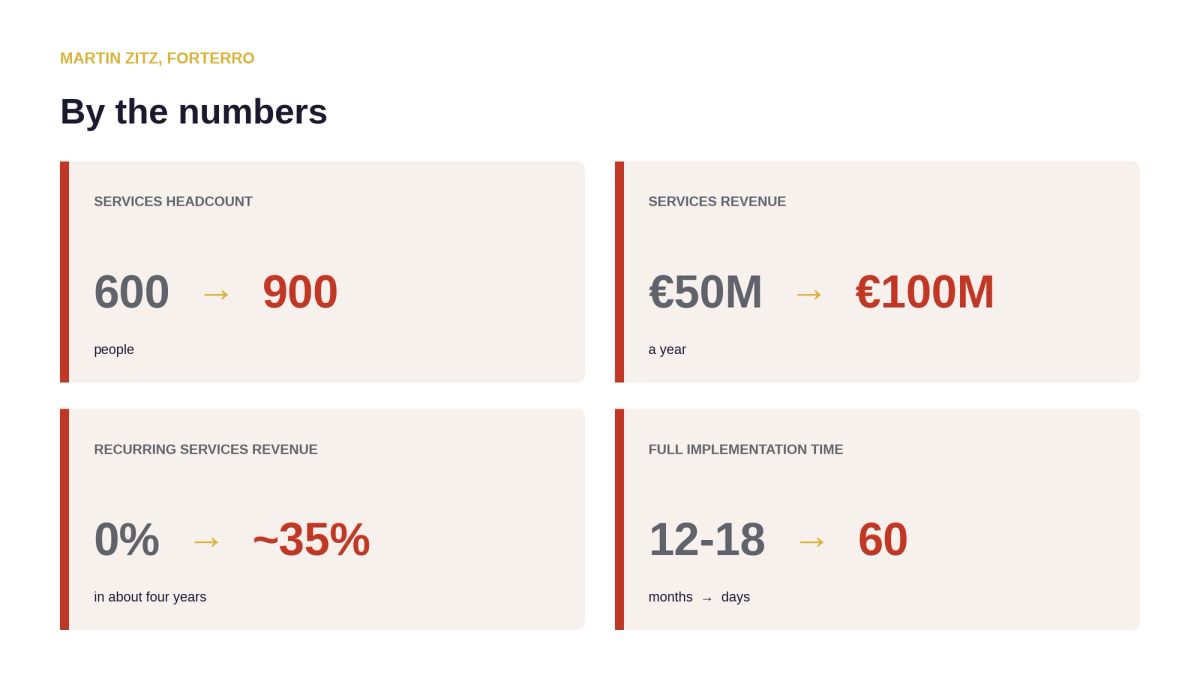
Martin Zitz, Senior Vice President of Service Operations at Forterro, inherited some fragmented, owner-led services businesses spread across Europe: roughly 600 people generating about €50 million in revenue, each local team selling and delivering services its own way. Today his professional services organization, at about 900 people, runs what Martin calls a €100 million operation. Revenue doubled on a headcount base that grew by half.
He made two changes: he replaced time-and-materials billing with a subscription pricing catalog, and he cut full implementations from 12-to-18 months down to 60 days.
TL;DR
- Revenue vs. headcount: scaled at twice the rate. 600 to 900 people; roughly €50 million to a €100 million operation.
- Recurring revenue: 0% to 35% in 5 years, built on a subscription catalog instead of time-and-materials billing.
- Implementation time: dropped from 12-to-18 months to 60 days, in a separate initiative from the pricing shift.
- AI: upgrade agents now move almost every customer to a new version within a few days; tailored support models resolve about 80% of Level 1 cases.
Change the KPI Before You Change the Price
During due diligence on the first acquisition Martin was part of, he asked one question: what was the profitability of this business? Nobody could answer. The company had about 100 people in professional services, had existed for 30 years, and had never logged a single hour in any system. “Service is profitability” was the closest thing to an answer Martin got: nobody there knew or measured it, they just kept delivering for as long as the customer kept asking.
At his first board meeting, the chairman asked how much he would grow services revenue. He told them the products business needed to grow and the customers needed to stay happy. Growing the services revenue line was never the goal. The board was surprised at first, but came round once they understood how services had been sold up to that point: pure time and materials, a bank of hours bought at the start of the year against a loose scope, with no real way to see whether any of it was profitable.
Martin also moved his teams away from what he calls the mantra of the billable hour. Billable hours, he says, no longer show whether someone’s work is valuable.
The Sell-Then-Cost Sequence
Replacing the rate card with a subscription service catalog ran in two phases. Sales priced the services first; then the delivery teams checked them.
| Timing | Phase | What happened |
|---|---|---|
| Months 1 to 3 | Price it from the customer's side | Sales defined what a customer did with each discrete service and what it was worth to them, arriving at roughly 40 priced items across each line of business. |
| Months 4 to 6 | Check it with delivery | Martin asked the services teams what they would charge a customer using all of those services, and what extra work was hidden behind them, mapping how the services depend on each other. Within 6 months, the first lines of business were ready and tested. |
He never started with the developers or the consultants. He went to the sales team first and asked, for each micro service, what the customer did with it and what they got out of it.
Forterro moved from 0% recurring services revenue to 35% inside 5 years, reaching that level in year 4. Net margin now sits solidly above 30%. When Martin first estimated profitability from inherited spreadsheets he got about 20%; once finance reconstructed the accounts, the real number was closer to single digits.
What Martin inherited was a set of Excel sheets and systems he calls “glorified time recording machines.” Two years in, he told his CEO there was no way they would hit their goals without a common platform and a common set of processes. Over the next 18 months, he and his team standardized the professional services organization on 54 processes and one common data platform. Since then, they can manage every type of engagement, including a portfolio of subscriptions, and check whether each one delivers, keeps the customer happy, and makes money.
The Grey Goose Problem
A pricing catalog does not sell itself to a client who has always called the same consultant for every change. Martin borrowed a name for that pattern from Konrad Lorenz, an Austrian researcher and Nobel Prize winner who found that a newly hatched grey goose imprints on the first moving animal it sees.
Grey Goose Syndrome is what happens when a customer’s first successful consultant becomes the only person they trust to touch anything again, regardless of whether the work was ever standardized into something the rest of the team could deliver.
“The first successful consultant they adopt as ‘Daddy,’ and Daddy needs to come back for every event they’re having. If it is a configuration, a pricing discussion, an upgrade, a change, it’s Daddy.”
If your clients keep coming back because they trust one consultant more than they trust your process, that dependence is what standardization threatens.
What helped, in Martin’s words, was luck. Many customers were going through a generation change, and the new owners liked paying a flat fee and didn’t mind who did the work. Customers are loyal, staying with their ERP vendor for 10 to 40 years, so word of the new model spread from customer to customer.
Where AI Actually Earned Its Keep
Martin described three ways Forterro uses AI. Two came with hard numbers.
Killed the manual migration bottleneck. Moving decades of customer customizations into a new version used to need a senior architect tracing them by hand, an effort measured in weeks or months. Roughly 100 upgrade agents now do that first pass in minutes; a senior architect validates. Almost every customer now upgrades within a few days.
Localized the language model rather than outsourcing it. Forterro works with a University of Munich spinoff on AI models that help its support team. 16 lines of business use them so far. Each product-specific model takes about 2 weeks to train, and together they resolve about 80% of Level 1 cases.
Martin wanted customer data owned and localized, not sent to the Americas or fed into a generic LLM. When asked whether he would rather build an AI-native ERP platform from scratch, Martin said no:
“AI means exactly nothing if you don’t have the right data.”
For customers, he said, data is king. If the data is right, you can put AI on top of it. If it isn’t, go back to square one and fix it. In Forterro’s situation, Martin said, it was “crucial, crucial, crucial” to standardize the offerings, bring people along on standardization, and build a data platform that lets the company use AI agents.
Where This Works, and Where It Doesn’t
When asked whether this would fail anywhere, Martin said yes: in a management consultancy, the customers expect a different product, so the offering itself would need rethinking before any of this applied. It works for software-related services. If what you sell isn’t tied to software, you need to rethink your offerings first.
When Martin ran PTC’s professional services worldwide, the environment was already mature and consistent. Margins ran 10 to 15 points above Forterro’s 30%, and offshore delivery was already set up. At Forterro, what he inherited was the opposite: no two people from two lines of business did the job the same way, even with the same title and the same statement of work.
Where Do You Stand?
- Does your core offering wrap around a product the client depends on operationally, or is it advisory work sold independent of any product? Martin’s approach assumes the former.
- Do you have delivery requirements specific enough to your industry that they would break if forced into one common process across every client? If not, more of your work is horizontal commons than you may be crediting.
- Would your own board tolerate a KPI change away from services revenue growth, the way Martin’s did, or is services revenue too politically load-bearing to touch first?
About Martin Zitz
Martin Zitz is Senior Vice President of Service Operations at Forterro, leading a professional services organization of around 900 people across its European ERP group. He brings 35 years of software consulting and operations experience, including roles at PTC and EMC.
This session was powered by Certinia, moderated by Paul Callaghan, RVP of Enterprise Sales EMEA. Certinia provides a Salesforce-native platform connecting sales, services and finance to help organizations scale more effectively.